
Early Career Researcher
Author of Framing Speciesism blog
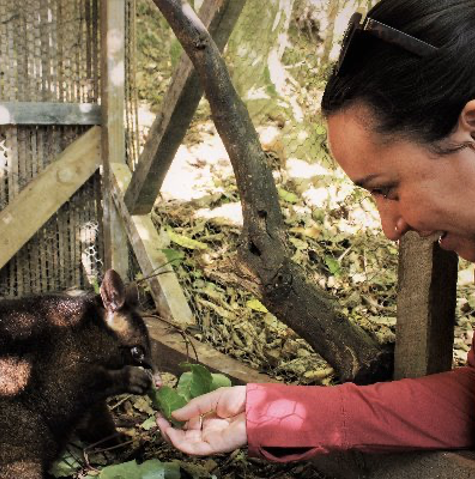
Emily Major is an early career researcher who uses Critical Animal Studies, ecofeminist ethics of care, and intersectional approaches with advocacy to promote empathy, compassion, and kindness to nonhuman animals. While she advocates for all species of animals, her current research interests are focused on species of animals that are ostracised in society, such as ‘pest’ or ‘invasive’ species.
Emily recently graduated with her PhD in Human-Animal Studies at the University of Canterbury in Ōtautahi | Christchurch, Aotearoa | New Zealand. Her doctoral research critiqued the mainstream possums as ‘pests’ discourse and considered how principles from compassionate conservation could assist in alleviating the socially sanctioned violence and cruelty that is currently targeted towards the maligned marsupials. Her research involved interviews and questionnaires from people who held ‘fringe’ viewpoints about conservation, possums, and ‘pest’ control in Aotearoa New Zealand. She has experience in qualitative thematic analysis, reflexive analysis, feminist interviewing, and observational fieldwork.
As Emily comes from a working-class background and is a first-generation university student, she recognises the need for higher education to be more accessible, community-minded, and transdisciplinary. To this end, she values grassroots advocacy and sees great potential in bridging the gaps between the humanities, social sciences, and natural sciences to find ways of considering animals which centres their interests and rights as a vital aspect of the conversation.
Since graduating, Emily has been active in writing article manuscripts and staying connected within her various roles, such as a committee member of the Australasian Animal Studies Association (AASA), a board member of the New Zealand Anti-Vivisection Society (NZAVS), and a member of the New Zealand Centre for Human-Animal Studies (NZCHAS). She has community experience volunteering with the Jane Goodall Institute of New Zealand and assisted in creating JGI’s ‘Embrace the Wild’ international campaign, which sought to educate and create habitats for animals in any urban or rural space for communities around the globe. In her role as a Research Fellow with PAN Works, Emily intends to use her existing knowledge of compassionate conservation, wild animal ethics, and ecofeminist ethics of care to contribute to conversations about ethics, animals, and society.
Professional Affiliations:
- Committee Member (Australasian Animal Studies Association)
- 2026 Junior Fellow at the Centre for Animal Ethics at the Universitat Pompeu Fabra in Barcelona
- Centre for Humane Education Member
- Research Fellow (PAN Works thinktank)
- Research & Ethics Advisor (New Zealand Anti-Vivisection Society)
- Member (Canadian Sociological Society)
- Affiliate (International Association of Vegan Sociologists)
Research Outputs:
- Major, E. & Taylor, N. (forthcoming 2026). ‘Pests’ and Environmental Ethics of Care: What about maligned species? Commissioned for the Springer Handbook for Environmental Philosophy.
- Major, E. (forthcoming June 2026). The Boogeymen of our Forests: Anti-Possum Rhetoric and the Construction of Fear in Dominant Conservation Messaging in Aotearoa New Zealand. Commissioned for Oxford Intersections. Oxford University Press.
- Major, E. (2025). Brushtail possums and species-inclusive social work in Aotearoa New Zealand. Aotearoa New Zealand Social Work, 37(1), 96-108.
- Major, E. (2024). 'Slayers, Rippers, and Blitzes: Dark Humor and Justification of Cruelty to Possums in Online Media in Aotearoa New Zealand'. Frontiers in Communication, 9. doi: 10.3389/fcomm.2024.1377559
Dissertations:
- Major, E. (2023). ‘Possums are as Kiwi as fish and chips’: Possum Advocacy and the Potential for Compassionate Conservation in Aotearoa New Zealand (Doctoral thesis, University of Canterbury).
- Major, E. (2017). 43 Days of Merazonia: How Speciesism Impacts the Rehabilitation and Release of Animals Affected by the Wildlife and Pet Trade in Mera, Ecuador (Master thesis, University of Exeter).
Podcast Interviews:
- ‘The Animal Turn’ Podcast Interview | 2025 | https://www.theanimalturnpodcast.com/s8-media/s8e4
- ‘Nights with Emile Donovan’ Radio New Zealand interview | 2024 | https://tinyurl.com/yz9t8n4v
- ‘The Deal with Animals’ Podcast Interview | 2021 | https://tinyurl.com/y6vfa246
- 3cR's "Freedom of Species" Podcast Interview | 2021 | https://tinyurl.com/y7tywd7v